










The best CRM for your small business depends on three things: the size of your team, your budget, and what you actually want it to do — drive sales, run marketing, or organize day-to-day operations. Every CRM software tool on this list does those jobs differently, and the right choice usually comes down to finding the balance between easy enough to actually use and powerful enough to grow with you.
We compared nine of the most popular options on the things that matter to a small business: price, ease of use, automation, integrations, and how quickly you can get value out of them.
CRM for small business
TL;DR — quick verdict:
- Best overall for Gmail & Google Workspace teams: NetHunt CRM
- Best free all-in-one: HubSpot CRM
- Best for sales-driven teams: Pipedrive
- Best value & scalability: Zoho CRM
- Best for visual workflows: monday CRM
- Best if you plan to scale up fast: Salesforce Starter Suite
- Best for AI lead scoring on a budget: Freshsales
- Best for solopreneurs who want simple: Less Annoying CRM
- Best for micro-teams on a tight budget: Bigin by Zoho
What is a CRM for small business (and do you actually need one)?
A CRM (customer relationship management) system for small business is software that stores your customer information and interactions in one place, tracks deals through a sales pipeline, automates repetitive work, and keeps your follow-ups and tasks organized so you close more deals.
How we evaluated these CRMs
These are the CRM features small businesses should pay attention to — and the criteria that actually determine whether a small team will adopt and benefit from a CRM. A CRM helps most when it fits the way your team already works, so these are the features to look for whether you're comparing two tools or ten:
- Ease of use — Can a non-technical team learn the basics in a day, without a consultant?
- Pricing & value — Transparent, per-user pricing that fits a small budget, plus a free plan or trial.
- Core features — Contact and sales management, task management, reporting, and mobile access. A flexible CRM should also offer a customizable range of CRM features for small businesses with different needs.
- Integrations — Especially email (Gmail/Outlook), plus the ability to integrate the other business apps you already use so all your customer data flows into one place.
- Scalability — A clear path to grow without ripping everything out and starting over.
- Support — Reachable help, tutorials, and onboarding for teams without an IT department.
Pricing below reflects published 2026 rates (annual billing unless noted) and may change — always confirm on each vendor's pricing page before buying.
The 9 best CRMs for small business in 2026
NetHunt CRM — Best for Gmail & Google Workspace teams
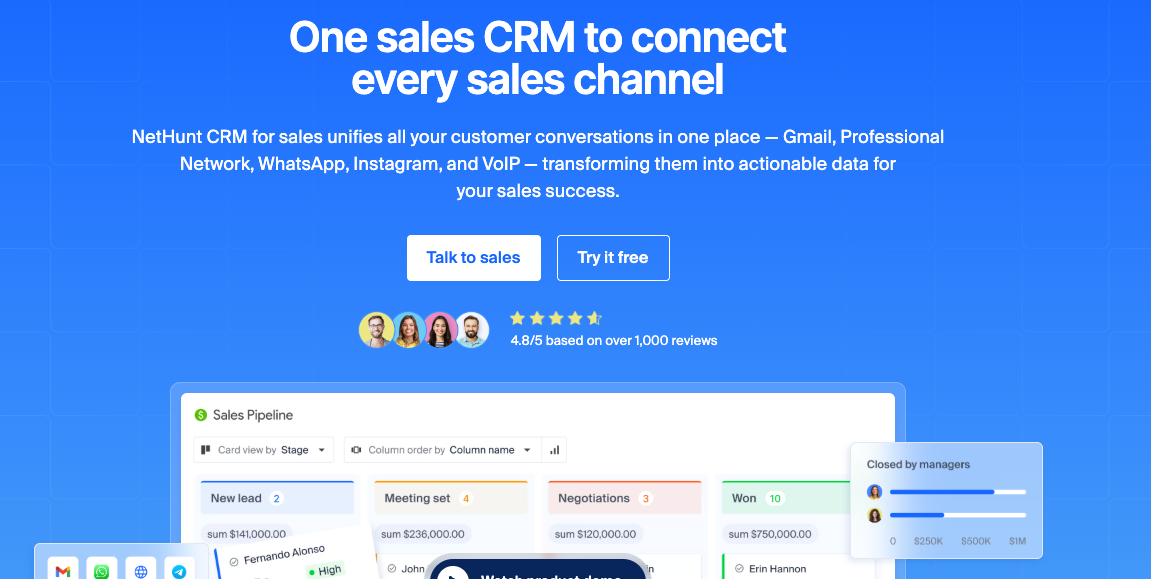
Our score: 4.5/5 🥇 — top marks for native Gmail integration (5.0) and multi-channel lead capture (5.0), with strong ease of use and support.
Why it shines: If your business runs through Gmail, NetHunt is the most natural fit on this list. It isn't a separate app you switch to — it's built right inside your Gmail inbox through a Chrome extension, so your CRM, contacts, deals, and pipelines live exactly where you already work. That single design choice removes the biggest reason small teams abandon a CRM: tab-switching and double data entry. For teams already on Google Workspace, setup takes minutes, not weeks.
Key features:
- Full CRM inside Gmail — view and edit contacts, deals, and pipelines without leaving your inbox.
- Multi-channel lead capture from Gmail, web forms, LinkedIn, Instagram, Facebook, WhatsApp, and VoIP calls.
- Sales automation for lead capture, lead scoring, lead distribution, drip campaigns, and pipeline updates — no code required.
- Built-in email tracking so you see when prospects open your emails and click links, then trigger timely follow-ups.
- Customizable contact management, reporting dashboards, and native mobile apps for iOS and Android.
- Deep Google integration: Calendar, file sharing, and Google Chat notifications.
Pricing: Five plans, all billed per user: Basic $24/mo, Basic Plus $34/mo, Business $48/mo, Business Plus $68/mo, and Advanced $96/mo. There's a 14-day free trial with access to core features, and qualifying startups under three years old can apply for a steep first-year discount on the Business plan.
Pros & cons:
| Pros | Cons |
|---|---|
| Truly native Gmail/Google Workspace experience | No free-forever plan (trial only) |
| Fast setup with no IT support | Per-user pricing adds up for very large teams |
| Multi-channel capture and multi-channel outreach built in | Integration ecosystem centers on Google + LinkedIn |
| Strong support and high ease-of-use ratings (G2 4.6) |
Best for: Small and mid-sized sales and marketing teams that live in Gmail and want a powerful CRM without leaving their inbox — including teams choosing a CRM for marketing agencies. If that's you, start a free NetHunt trial and you can have a working pipeline the same day.
What users say:
I mainly use NetHunt CRM for managing leads, tracking customer communication, organizing sales pipelines, and handling follow-ups directly through Gmail. I like its seamless Gmail integration and user-friendly interface, which makes managing emails, leads, and follow-ups convenient without needing to switch between multiple tools.
The pipeline tracking and automation features help save a lot of time for the sales team. The Gmail integration is especially valuable because I can manage customer conversations, update lead information, and track email history directly from the inbox. The automation features help by assigning tasks, sending follow-up reminders, and updating deal stages automatically, which saves time and reduces manual work.
I also found the initial setup relatively easy thanks to the direct Gmail integration. Basic features like contact management, pipelines, and email tracking were quick to configure. Overall, these features improve productivity and help the team respond to customers more efficiently.
What do you dislike about NetHunt CRM?
One area that could be improved is the reporting and dashboard customization, as some advanced reports take time to configure. Occasionally, the platform can feel slightly slow when handling larger datasets or multiple workflows. More third-party integrations and simpler setup for advanced automation would also make the experience even better.
What problems is NetHunt CRM solving and how is that benefiting you?
I use NetHunt CRM to streamline lead management and customer communication directly through Gmail. It centralizes client information, reduces manual tracking, and helps ensure no follow-ups or sales opportunities are missed. This has improved team coordination and made our sales process more organized and efficient.
Zoho CRM — Best for value & scalability
Our score: 4.1/5 — the best value on the list (5.0), with strong automation and customization; a slightly steeper learning curve.
Why it shines: Zoho CRM packs an enterprise-grade feature set into budget-friendly pricing, and it plugs into the massive Zoho ecosystem (Books, Campaigns, Desk, and more). It's the value pick for growing businesses that want to automate serious work without enterprise costs.
Key features:
- Lead management, lead scoring, and automated lead nurturing.
- 360-degree customer view aggregating emails, calls, social, and deals.
- Advanced AI assistant (Zia), deep layout customization, and custom modules.
- Social media management and SalesSignals real-time notifications.
Pricing: Free for up to 3 users. Paid plans: Standard $14/user/mo, Professional $23/user/mo, Enterprise $40/user/mo, Ultimate $52/user/mo (annual). The free plan is genuinely usable, not a crippled trial.
Pros & cons:
| Pros | Cons |
|---|---|
| Most features per dollar | Interface can feel busy |
| Generous free plan (3 users) | Steeper learning curve for advanced features |
| Scales from solo to enterprise | Best value requires staying in the Zoho ecosystem |
Best for: Growing businesses that want to automate at scale on a budget. See the NetHunt vs Zoho comparison for the differences that matter.
What users say:
I appreciate the ease of navigation and the helpful features in Zoho CRM. It's an intuitive platform, making it easy for me to keep all leads and clients in one place. I like that everything, including inventory, can be kept in one place, and I can even set sales goals for my employees.
The search bar is also a helpful feature. The initial setup was easy, and I am thrilled with how it allows easy communication via email. I also appreciate their built-in AI tool in the email feature. Pricing is also affordable. As a nonprofit, we are price conscious, and they have a discount for nonprofits. I haven't tried any integrations yet but I am curious what functionality it can offer in that regard.
What do you dislike about Zoho CRM?
It's quite a lot of features, so sometimes it takes a long time to navigate to where I need to go.
What problems is Zoho CRM solving and how is that benefiting you?
Zoho CRM provides an intuitive platform that keeps all leads, clients, and inventory in one place, making it efficiently easy to use.
HubSpot CRM — Best free all-in-one platform
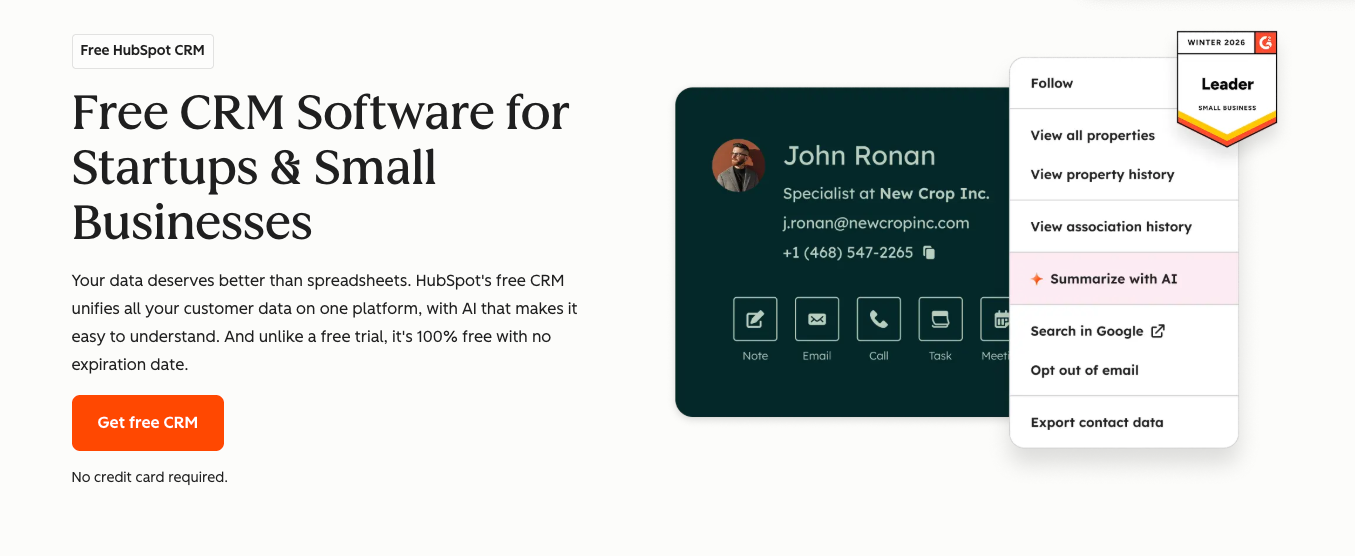
Our score: 4.0/5 — strongest on its all-in-one breadth and scalability (4.5); value dips because paid tiers climb fast.
Why it shines: HubSpot offers one of the most generous free CRMs on the market, and HubSpot's free CRM pairs the core CRM with free marketing, sales, and service tools. For a small business that wants room to add inbound marketing, landing pages, and content as it grows, the all-in-one platform is a strong draw — and you can start at zero cost. Its Smart CRM connects your essential business tools so customer data, marketing, and reporting live together.
Key features:
- Free contact and deal management with a large contact limit.
- Email tracking, templates, meeting scheduling, and live chat.
- Marketing tools: forms, landing pages, ad management, and email marketing.
- Reporting dashboards and business intelligence, plus a marketplace of 2,000+ app integrations — see how CRM dashboards differ across platforms.
Pricing: Free forever (with limits). The Starter Customer Platform starts at $15/seat/mo (billed annually); Professional tiers jump to around $100/seat/mo and up, which is where costs escalate quickly.
Pros & cons:
| Pros | Cons |
|---|---|
| Excellent free tier to get started | Paid tiers get expensive fast |
| All-in-one marketing + sales + service | Free plan limited to a couple of seats |
| Huge integration marketplace | Advanced tools and reporting locked behind Pro pricing |
Best for: Marketing-led teams that want a free starting point and plan to scale into inbound marketing. See how it stacks up in our NetHunt vs HubSpot comparison.
What users say:
What I like best about HubSpot Sales Hub is how easy it makes it to manage the full sales workflow in one place. The pipeline view gives a clear overview of deal stages, tasks, and next steps, while sequences, templates, and automated follow-ups save a lot of manual work each week.
I also find the AI features useful for speeding up smaller tasks, such as summarizing activity, drafting emails, and getting quicker context before following up with a prospect. An unexpected benefit is how much easier it becomes to keep sales data clean and visible across the team, which helps with both daily prioritization and reporting.
What do you dislike about HubSpot Sales Hub?
What I dislike about HubSpot Sales Hub is that some advanced workflows, reporting views, and CRM customization options can become difficult to manage as the sales process becomes more complex. The core UI is easy to use, but deeper configuration often requires trial and error, especially when building automation or trying to structure data in a very specific way.
I also think the AI features are useful, but they can still feel a bit generic and sometimes need heavy editing before they are ready to use. Better guidance inside the platform and more flexible customization options would make the tool stronger for scaling sales teams.
What problems is HubSpot Sales Hub solving and how is that benefiting you?
HubSpot Sales Hub solves the problem of having sales activity spread across too many places. Before using it, it was harder to keep a clear overview of deal progress, follow-ups, tasks, and customer interactions.
Now, the pipeline view, activity timeline, sequences, templates, and automated task reminders make it easier to manage deals consistently and avoid missed follow-ups. This saves time each week and makes the sales process more structured. The AI features also help by summarizing context, supporting email drafting, and making it faster to prepare for follow-ups. Overall, HubSpot Sales Hub helps improve visibility, prioritization, and consistency across the sales workflow.
Freshsales — Best for AI lead scoring on a budget
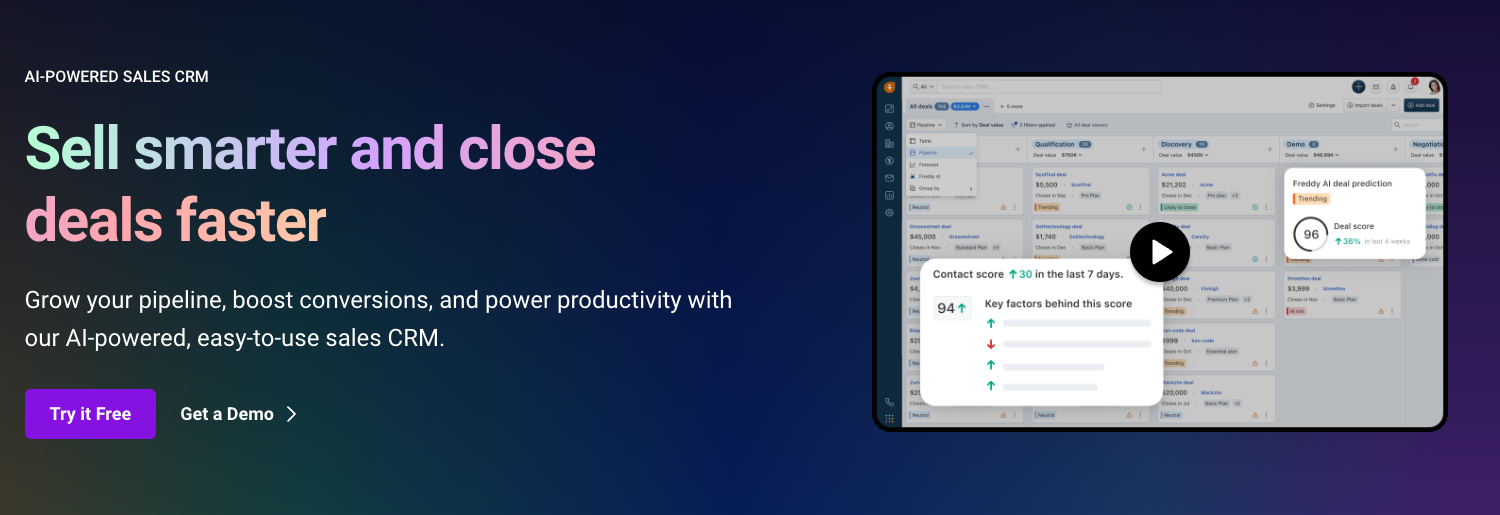
Our score: 4.0/5 — strong value (4.5) thanks to AI and a built-in phone at the lowest paid entry price; lighter integration ecosystem.
Why it shines: Freshsales (by Freshworks) leads with AI. Its Freddy AI scores leads, surfaces deal insights, and suggests next best actions — features that usually cost far more elsewhere. Pair that with a built-in phone dialer and one of the lowest entry prices on the market, and it's a standout for sales teams that want intelligence without complexity.
Key features:
- Freddy AI lead scoring, deal insights, and recommendations.
- Built-in phone, email, and chat — omnichannel out of the box.
- Visual sales pipelines, contact lifecycle tracking, and sales sequences.
- Free plan with unlimited contacts for up to 3 users.
Pricing: Free for up to 3 users. Growth $9/user/mo, with Pro (where AI features expand) around $39/user/mo (annual). The Growth tier undercuts almost every competitor while still including email tracking and automated follow-ups.
Pros & cons:
| Pros | Cons |
|---|---|
| Cheapest real CRM at the Growth tier | Thinner integration marketplace (~300 apps) |
| AI scoring + built-in phone | Free plan capped at 1,000 contacts |
| User-friendly, fast to deploy | Less deep customization than Zoho |
Best for: Budget-conscious sales teams that want AI lead scoring and built-in calling.
What users say:
Freshsales is easy to use and everything is in one place. I like the lead tracking and email follow-ups, it saves time and keeps things organized. The pipeline view also helps me clearly see deals and focus on the important ones.
What do you dislike about Freshsales?
At times, it feels a bit slow, and in the beginning some features take a while to understand. A few of the more advanced options also aren’t very easy to find, which can make navigation a little frustrating at first.
What problems is Freshsales solving and how is that benefiting you?
It solves the problem of scattered leads and missed follow-ups. With everything in one place, I can track leads more easily and stay consistent with my follow-ups. As a result, I manage deals better and save time.
Pipedrive — Best for sales-driven teams
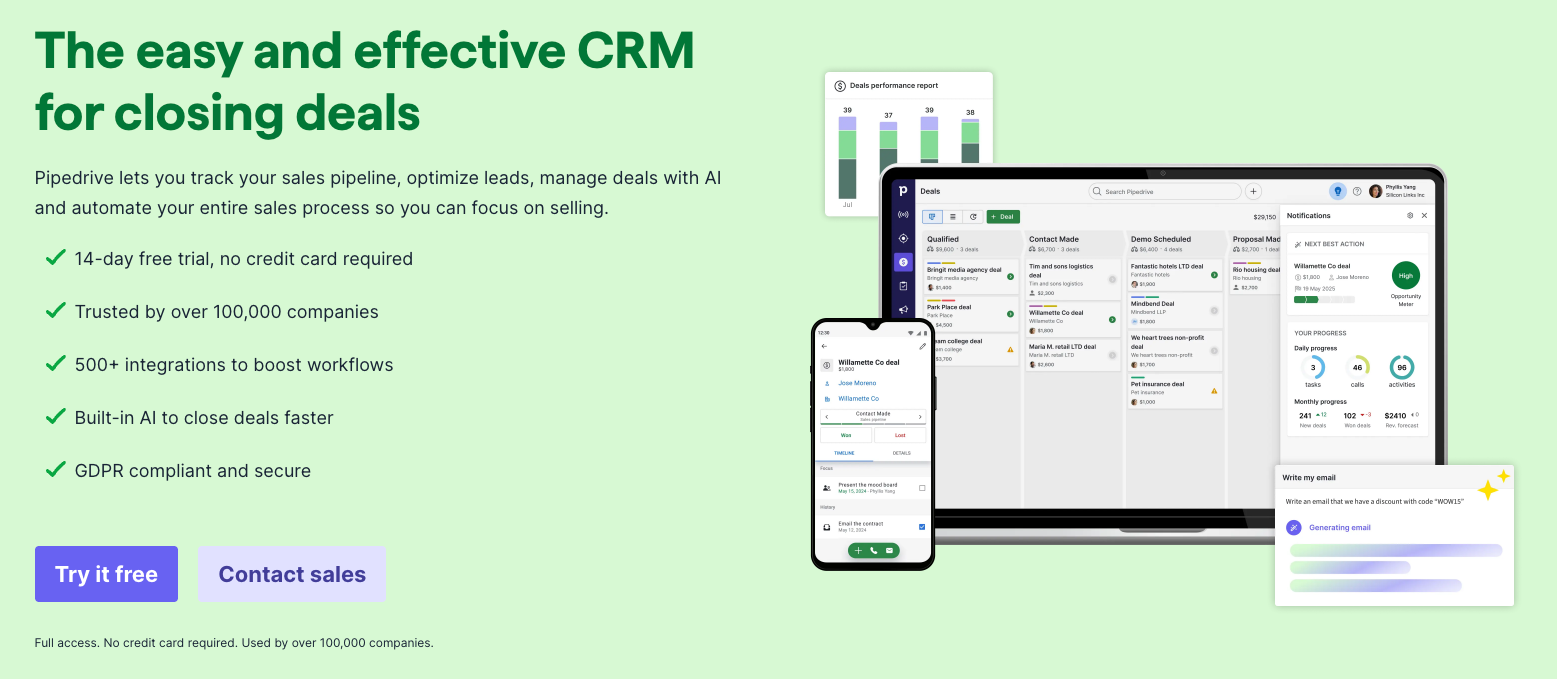
Our score: 3.9/5 — high marks for ease of use (4.5) and fast setup (4.5); held back on multi-channel capture.
Why it shines: Built by salespeople for salespeople, Pipedrive is laser-focused on one thing: moving deals through a visual, drag-and-drop pipeline. It's intuitive to set up and a favorite of solopreneurs and small sales teams who want a clean, clutter-free experience without marketing-suite bloat.
Key features:
- Highly visual, customizable pipeline with unlimited contacts on every plan.
- Email sync, open/click tracking, and automated follow-ups (from the Advanced tier).
- Built-in calling, web forms, and solid mobile apps.
- AI deal-scoring and sales assistant on higher tiers.
Pricing: No free plan, but a 14-day free trial. Plans start at $14/user/mo (annual) and rise to roughly $99/user/mo at the top tier. Email tracking and automated follow-ups kick in at the second tier (~$29–$34/user/mo).
Pros & cons:
| Pros | Cons |
|---|---|
| Clean, sales-focused interface | No free plan |
| Quick to set up and learn | Light on marketing and service features |
| Transparent, affordable entry price | Add-ons (LeadBooster, etc.) raise the real cost |
Best for: Solopreneurs and small sales teams that want a simple, deal-focused CRM. Compare it directly in our NetHunt vs Pipedrive breakdown.
What users say:
What I value most is how simple and intuitive Pipedrive is to use, which matters a lot when you need a whole commercial team adopting it consistently. The level of customization stands out: I can adapt pipeline stages, custom fields, and activity types to fit how we actually sell rather than forcing our process into a rigid template.
Over the past 7 years of using it across our 10-person sales team, it has evolved in a direction that fits our organizational needs well, which has eliminated any need to migrate to another platform. The initial setup was genuinely fast — we were running our first pipelines within a couple of days — and onboarding new team members has been straightforward thanks to the clean interface.
What do you dislike about Pipedrive?
There are a few minor limitations, mostly around the management of certain data and how some objects interconnect. For example, you can't link a single person to multiple organizations or defining Analytics for Projects could be smoother. That said, these are small frictions and negligible compared to the overall benefit we get.
What problems is Pipedrive solving and how is that benefiting you?
Pipedrive solves the continuity of information within our team and prevents data loss during turnover — when someone leaves or a deal is handed over, the full history stays in one place. Concretely, it gives us constant, shared access to crucial client information so we can manage over 500 active clients effectively and plan follow-up actions without anything falling through the cracks.
Since adopting it, our follow-up consistency has improved and we've cut the time spent on manual handover notes. This fluidity of information is the single biggest benefit for us.
Bigin by Zoho — Best for micro-teams on a budget
Our score: 3.9/5 — best value (5.0) and very easy to set up; lighter on automation and harder to scale beyond a micro-team.
Why it shines: Bigin is Zoho's pipeline-first CRM built specifically for the smallest teams — and it's the cheapest real CRM here. It earned PCMag's Editors' Choice for small business thanks to flexible dashboards and surprisingly broad integrations for the price. If you want a CRM that costs less than a streaming subscription, this is it.
Key features:
- Pipeline-centric design with task, deal, and contact management.
- Free plan for solopreneurs; built-in telephony and email on paid tiers.
- Connected pipelines for sales, onboarding, and post-sale workflows.
- Native mobile apps and Zoho ecosystem integrations.
Pricing: A free plan for solo users. Paid plans start at Express $7/user/mo, scaling up modestly from there — the lowest paid entry point on this list.
Pros & cons:
| Pros | Cons |
|---|---|
| Extremely affordable | Lighter on advanced features |
| Easy for micro-teams to adopt | Outgrown faster than full Zoho CRM |
| PCMag Editors' Choice | Best value only inside Zoho's ecosystem |
Best for: For solopreneurs and micro-teams (1–5 people) who want a proper CRM at the lowest possible cost — the same logic applies when picking a real estate CRM as a solo agent
What users say:
Small teams wanting affordable CRM with Ecosystem + integrations
What do you dislike about Bigin by Zoho CRM?
Well some advanced features require add-ons
What problems is Bigin by Zoho CRM solving and how is that benefiting you?
Bigin by Zoho CRM has helped us centralize lead management from multiple channels and bring structure to our sales and follow-up process. Previously, inquiries from website forms, social media, WhatsApp, and referrals were managed across different tools, making it difficult to track customer interactions and ensure timely follow-ups.
With Bigin, we are able to organize leads through customizable pipelines, assign ownership to team members, track activities, and maintain visibility into the status of every opportunity. The platform is intuitive, easy to adopt, and well-suited for growing teams that need a simple yet effective CRM solution.
The biggest benefit for us has been improved lead visibility, better follow-up management, and having a single source of truth for customer interactions. As we continue evaluating the platform, we are particularly interested in its integration capabilities and how it can support our business growth across multiple channels.
monday CRM — Best for visual workflows & customization
Our score: 3.8/5 — top customization and scalability (4.5); value dips because of the 3-seat minimum.
Why it shines: monday CRM is the visual, colorful side of customer management. Built on monday.com's work-platform foundation, it doubles as a CRM and a project manager, which makes it ideal for teams that want to combine deal tracking with operations in highly customizable boards.
Key features:
- Unlimited, customizable pipelines and contact management.
- Built-in AI assistants and dynamic pipeline management.
- Two-way email integration, automations, and sales analytics on higher tiers.
- Drag-and-drop visual boards that anyone can configure.
Pricing: No standalone free CRM plan (14-day trial). Basic $12/seat/mo, Standard $17/seat/mo, Pro $28/seat/mo (annual). Note the 3-seat minimum on all paid plans, which raises the real entry cost for solo users.
Pros & cons:
| Pros | Cons |
|---|---|
| Beautiful, highly visual interface | 3-seat minimum inflates cost for tiny teams |
| Doubles as project management | Automations limited on the Basic plan |
| Very customizable boards | Can be more than a pure sales team needs |
Best for: Visual learners and teams that want CRM + project management in one. Compare in NetHunt vs monday.
What users says:
I find it very useful because of its AI-powered features, which make creating forms, workflows, and automations smooth. It’s easy to collaborate with team members, keep information organised, and manage tasks in one place. The platform is multifunctional and flexible, making it suitable for a wide range of business and project management needs.
What do you dislike about monday CRM?
One thing I dislike is that the layout and setup can take some time to get used to at first, and editing the forms can feel a bit finicky at times. However, once you become familiar with the platform, it becomes much easier to navigate and use effectively.
What problems is monday CRM solving and how is that benefiting you?
One problem it has helped solve is creating quotes for exhibitors who would like to work with us, as well as improving our automation processes. We previously had issues with how we were going to use forms externally, but Monday CRM has helped a great deal by making external forms and data collection much more manageable.
Less Annoying CRM — Best for solopreneurs & simplicity
Our score: 3.8/5 — perfect scores for ease of use (5.0) and support (5.0); naturally limited on automation and multi-channel capture.
Why it shines: The name is the promise. Less Annoying CRM strips away everything complicated and gives you a single, flat-priced plan with no tiers, no upsells, and no learning curve. It consistently earns the highest user-satisfaction scores in the category (G2 4.9) precisely because it does less — on purpose.
Key features:
- One plan, every feature included — no tier confusion.
- Unlimited, customizable contact and pipeline fields.
- Automatic logging of emails, meetings, and completed tasks.
- Works in any browser on mobile and desktop; one-click exports.
Pricing: A single flat plan at $15/user/mo, with a 30-day free trial. That's it — no add-ons, no premium tiers.
Pros & cons:
| Pros | Cons |
|---|---|
| Genuinely simple, near-zero learning curve | Not built for complex sales processes |
| Flat, predictable pricing | Limited advanced features |
| Top-rated support | Fewer integrations than larger platforms |
Best for: Solopreneurs and very small teams that want a no-fuss CRM and nothing more.
What users say:
It’s very straightforward to use, and I’ve found it easy to integrate into my routine. All the forms, including pipelines and contacts, are simple to modify, without becoming so cumbersome that you end up not using it. It was very easy to pick up and the interface is quick.
What do you dislike about Less Annoying CRM?
It doesn’t work well with Microsoft products. For example, you can’t maintain a single address book that links CRM and email contacts. It also isn’t very smart in how it handles planning and follow-ups. I’d like to create task reminders for things like registering for future conferences or keeping an eye on proposal dates, but there doesn’t seem to be a way to connect these kinds of events or track them together.
What problems is Less Annoying CRM solving and how is that benefiting you?
It is helping us develop business development routines and keep track of all the conferences and events coming up that we may or may not be personally attending.
Salesforce Starter Suite — Best if you plan to scale up fast
Our score: 3.3/5 — unmatched scalability (5.0), but the lowest scores on value, setup, and support for a small team.
Why it shines: Salesforce is the world's most recognized CRM, and its Starter Suite is the on-ramp for small businesses that expect to grow into a much bigger operation. The appeal isn't simplicity — it's knowing you'll never outgrow the platform, with an unmatched ecosystem of add-ons and integrations waiting when you need them.
Key features:
- All-in-one sales, service, marketing, and commerce tools in one suite.
- Email marketing and basic process guidance at the Starter level.
- Massive AppExchange marketplace and AI (Einstein/Agentforce) on higher tiers.
- Slack included with the Starter Suite.
Pricing: A free Starter Suite trial (and a small Free Suite for up to 5 users). Starter Suite $25/user/mo; the next step up, Pro Suite, jumps to $100/user/mo (annual).
Pros & cons:
| Pros | Cons |
|---|---|
| Endless room to scale | Priciest entry point on this list |
| Industry-leading ecosystem | Big jump from Starter to Pro Suite |
| All-in-one Starter Suite | Can feel heavy for a small team's needs |
Best for: Ambitious small businesses that want to future-proof their CRM choice. See NetHunt vs Salesforce if you'd rather keep things lightweight.
Best small business CRM software in 2026 — quick comparison
Ranked by our weighted overall score. The best CRM software for small business balances price, ease of use, and a customizable feature set — so before you commit, it helps to see all the CRMs for small businesses side by side. The table below compares core features and CRM pricing at a glance; if you've decided you need CRM software but aren't sure which tier fits, this is the fastest way to shortlist.
| CRM | Our score | Best for | Free plan | Starting price | G2 rating |
|---|---|---|---|---|---|
| NetHunt CRM | 4.5 🥇 | Gmail & Google Workspace teams | 14-day trial | $24/user/mo | 4.6 |
| Zoho CRM | 4.1 | Value & scalability | Up to 3 users | $14/user/mo | 4.3 |
| HubSpot CRM | 4.0 | Free all-in-one | Free forever | $15/seat/mo | 4.4 |
| Freshsales | 4.0 | AI lead scoring on a budget | Up to 3 users | $9/user/mo | 4.5 |
| Pipedrive | 3.9 | Sales-driven teams | 14-day trial | $14/user/mo | 4.3 |
| Bigin by Zoho | 3.9 | Micro-teams on a budget | Free (solo) | $7/user/mo | 4.6 |
| monday CRM | 3.8 | Visual workflows & customization | Trial only | $12/seat/mo | 4.6 |
| Less Annoying CRM | 3.8 | Solopreneurs & simplicity | 30-day trial | $15/user/mo (flat) | 4.9 |
| Salesforce Starter Suite | 3.3 | Scaling up fast | Free Suite (5 users) | $25/user/mo | 4.4 |
Scores are our weighted average (out of 5). Prices are per user/seat per month, billed annually, as of 2026.
How we scored each CRM
To rank these tools objectively, we scored each one from 1.0 to 5.0 across eight criteria that reflect what actually matters when a small business chooses a CRM. Each criterion carries a weight based on how critical it is for a small team — the factors that decide whether a CRM gets adopted (or quietly abandoned) carry the most weight.
| Criterion | Why it matters for small business | Weight |
|---|---|---|
| Ease of use | No time or IT team for training — the interface has to make sense on day one | 18% |
| Value for money | Limited budgets; you should only pay for what you actually use | 16% |
| Email & Google Workspace integration | Most small businesses run on Gmail and email — the CRM should live where you already work | 16% |
| Setup & time to value | It needs to work within a day, without developers or consultants | 14% |
| Sales & workflow automation | A small team has to automate the busywork to keep selling | 12% |
| Multi-channel lead capture | Leads arrive from email, social, messengers, and calls — none should slip away | 10% |
| Customization & scalability | The CRM should grow with your business, not force a migration | 8% |
| Customer support | With no in-house IT, fast and reachable help is essential | 6% |
Each tool's overall score is the weighted average of these eight ratings. You'll find the full score in the comparison table below and at the top of every review.
The complete scoring matrix
We rated all nine CRMs from 1.0 to 5.0 across eight weighted criteria — ease of use, value, integrations, automation, and more — to give each tool one comparable score. The table below shows overall scores, core features, and CRM pricing at a glance. For the reasoning behind every individual rating, see our full scoring methodology.
| CRM | Ease of use | Value | Email/Google | Setup | Automation | Multi-channel | Custom/Scale | Support | Overall |
|---|---|---|---|---|---|---|---|---|---|
| NetHunt CRM | 4.5 | 4.0 | 5.0 | 4.5 | 4.5 | 5.0 | 4.0 | 4.5 | 4.5 |
| Zoho CRM | 3.5 | 5.0 | 4.0 | 3.5 | 4.5 | 4.0 | 4.5 | 3.5 | 4.1 |
| HubSpot CRM | 4.0 | 3.5 | 4.0 | 4.0 | 4.0 | 4.0 | 4.5 | 4.0 | 4.0 |
| Freshsales | 4.0 | 4.5 | 3.5 | 4.0 | 4.0 | 4.0 | 3.5 | 4.0 | 4.0 |
| Pipedrive | 4.5 | 4.0 | 3.5 | 4.5 | 4.0 | 3.0 | 3.5 | 4.0 | 3.9 |
| Bigin by Zoho | 4.5 | 5.0 | 3.5 | 4.5 | 3.0 | 3.0 | 3.0 | 4.0 | 3.9 |
| Less Annoying CRM | 5.0 | 4.5 | 3.0 | 5.0 | 2.5 | 2.5 | 3.0 | 5.0 | 3.9 |
| monday CRM | 4.0 | 3.5 | 3.5 | 4.0 | 4.0 | 3.5 | 4.5 | 4.0 | 3.8 |
| Salesforce Starter Suite | 3.0 | 2.5 | 3.5 | 2.5 | 3.5 | 3.5 | 5.0 | 3.0 | 3.2 |
How to choose the best CRM for your small business
With nine solid options, the way to choose a CRM comes down to your specific business needs. There's no single best CRM software for small teams — the right CRM is the one that fits how you work. Use these scenarios to find the best CRM for your situation:
- You run your business through Gmail / Google Workspace. Choose NetHunt CRM. A CRM that lives inside the inbox you already use all day gets adopted instead of abandoned — and that's the single biggest predictor of CRM success.
- You're a sales-first team that just wants to move deals. Choose Pipedrive for its clean visual pipeline.
- You're marketing-led and want a free starting point. Choose HubSpot CRM and add marketing tools as you grow.
- You want the most features for the least money. Choose Zoho CRM (or Freshsales if AI lead scoring is the priority).
- You're a solopreneur who hates complexity. Choose Less Annoying CRM or Bigin by Zoho for budget.
- You expect to scale into a large operation. Choose Salesforce Starter Suite to future-proof.
- You want CRM and project management together. Choose monday CRM.
Whichever you lean toward, make sure the CRM offers a free plan or trial so you can test it risk-free, and confirm the CRM provider handles your data securely and is easy to reach for support. Most small businesses need a tool that's quick to set up and simple to run — heavy platforms create the CRM challenges salespeople complain about most. A customizable CRM that lets you create custom fields and views will help small teams adapt it to their own sales and business development process as they scale. Used consistently, a CRM provides the visibility that drives smarter decisions — and that's one of the core benefits of small business CRM adoption.
A quick gut check: the best CRM is the one your team will actually use every day. Businesses that use CRM software consistently see the biggest gains — but if a tool requires switching contexts, manual data entry, or a week of training, CRM adoption stalls. That's exactly why a Gmail-native option like NetHunt wins for so many small businesses — the CRM meets people where they already work.
Signs your small business needs a CRM
Many small businesses run on spreadsheets at first, but a few signs make it clear why your business needs a CRM:
- You're juggling 10 or more active leads or customers across spreadsheets, notebooks, and inboxes.
- Team members miss follow-ups because tasks slip through the cracks, and deals stall in the sales cycle.
- You spend two or more hours a week on manual data entry instead of selling and closing deals.
- Customer details live in individual email inboxes, so nobody else can pick up a conversation.
- You can't quickly answer "What's our pipeline worth?" or "Who needs a follow-up today?"
If two or more of those sound familiar while running a small business, the question isn't whether to adopt a CRM — it's which one.
Getting started with your CRM (in under a day)
Whichever tool you choose, the path to CRM implementation is similar. Here's how to start using a CRM and managing your CRM day to day — using NetHunt as the example:
- Set up your ecosystem. Log into the web app, install the mobile apps, and add the Gmail Chrome extension. You'll be able to work leads from every channel right away.
- Import your data. Bring contacts over from spreadsheets — the CRM automatically maps fields, imports comments, and checks for duplicates so your database starts clean.
- Connect your channels. Route email, social, and messenger conversations inside your CRM so nothing lives in a personal inbox, and log sales activities against every contact automatically.
- Customize to your process. Adjust the default Companies, Deals, and Contacts folders, add custom fields, and set up the reports and views that matter to you. A good CRM platform allows you to personalize layouts without code.
- Pick your plan. Start small to test the waters, then add users as your business grows. See current pricing.
None of these steps require technical skills — and most teams finish in less than a workday.
Final verdict
There's no single best CRM software for every small business — but there is a best fit for your team. If you want the cheapest entry point, Bigin and Freshsales are hard to beat. If you want a free all-in-one, HubSpot delivers. If you live in deals, Pipedrive is built for you. And if you want the most advanced CRM features per dollar, Zoho wins on value.
But for the large and growing number of small businesses that run on Gmail and Google Workspace, NetHunt CRM is the best overall choice. It's the only option here that turns your inbox itself into a full CRM — with multi-channel lead capture, no-code automation, and email tracking built in — so you can prospect, forecast, and help your team close more deals without ever leaving the tools they already use. Want to learn more about the benefits? Try NetHunt CRM free and see the difference in a day.
FAQ
What is the best CRM for small business in 2026?
It depends on your team and goals, but the top contenders are NetHunt (best for Gmail/Google Workspace teams), HubSpot (best free all-in-one), Pipedrive (best for sales-focused teams), and Zoho CRM (best value). For Google-based small teams, NetHunt is the standout because it works natively inside Gmail.
What is the best free CRM for small business?
HubSpot CRM offers the most generous free-forever plan, while Zoho CRM and Freshsales both include solid free tiers for up to 3 users, and Bigin by Zoho has a free plan for solopreneurs. Free plans are a great way to test a tool before committing to a paid tier.
What is the cheapest CRM for small business?
Bigin by Zoho is the cheapest real CRM, starting at around $7/user/month, followed by Freshsales at $9/user/month. monday CRM ($12), Pipedrive ($14), and Zoho CRM ($14) round out the budget options.
What is the best CRM for Gmail and Google Workspace?
NetHunt CRM is purpose-built for Gmail and Google Workspace — it runs inside your Gmail inbox via a Chrome extension and syncs with Google Calendar, Drive, and Chat, so there's no tab-switching or duplicate data entry.
How much does a CRM for small business cost in 2026?
Most small business CRMs range from free to about $100/user/month. Entry-level paid plans typically run $7–$25/user/month for core features, mid-tier plans $25–$50/user/month add deeper reporting and analytics, and premium tiers run $60–$100+/user/month. Many vendors also offer free plans or trials.
Is NetHunt CRM easy to use if I have no technical skills?
Yes. NetHunt is built inside Gmail with a clean, intuitive interface and no steep learning curve. Setup takes minutes, no IT support is required, and the Help Center, blog, and support team are available if you get stuck.
Which CRM is best for a one-person business?
For solopreneurs, Bigin by Zoho (cheapest), Less Annoying CRM (simplest), and Freshsales (best free AI features) are all excellent choices. If you run your business through Gmail, NetHunt's free trial is worth testing too.
How do I switch from spreadsheets to a CRM?
Start by cleaning your spreadsheet data (remove duplicates, standardize names), then follow a step-by-step process to migrate from Excel to a CRM — importing your most important contacts first, then the rest in batches. Map your existing sales process to the CRM's pipeline stages, then train your team to use the CRM consistently. Most modern CRMs map your data automatically and can have you up and running in under a day.



 product experts — let's find the best setup for your team