








The landscape of search engine optimization has never been more competitive or complex than it is today. In 2026, SEO agencies face a unique set of challenges backed by powerful statistics. For example, a recent industry survey found that 70% of agencies are small operations making under $50,000 in monthly recurring revenue, and over half of these agencies operate on gross margins below 30%. Search algorithms are now heavily driven by artificial intelligence, over 63% of agencies have shifted their SEO KPIs to address the rise of AI overviews, and client expectations for immediate transparency are higher than ever. Meanwhile, 39.7% of agencies cite lead generation as their main growth hurdle and nearly half name fierce competition as the biggest pricing barrier. With the volume of data required to make informed decisions rapidly increasing and the market expecting faster, clearer results, operational efficiency is now more essential than ever for agency survival and growth.
For many agencies, the biggest hurdle is not a lack of SEO knowledge but operational inefficiency. Recent data shows that 60.3% of agencies are now investing in automation to reduce delivery costs, while tool fragmentation causes substantial delays for most teams. Agencies using more than five separate SEO tools often spend over 20 hours monthly on manual reporting and data consolidation, which directly impacts scalable growth. If your team is spending more time wrangling data across multiple tabs than executing impactful strategies, your agency may be falling behind competitors that are already streamlining operations with all-in-one solutions.
This guide will show you exactly how to streamline your operations, build unbreakable client trust, and achieve substantially better results with all-in-one SEO management software. In fact, according to recent industry data, agencies shifting to unified platforms report saving up to 50% of the time previously spent on reporting and administrative tasks, while 56.2% have successfully raised retainer prices by delivering greater transparency and efficiency to clients. By the end of this guide, you will see how consolidating workflows empowers your agency to transition from a stressed, reactive team into a highly scalable, data-driven powerhouse.
The Problem with Traditional SEO Agency Workflows
For years, the standard operating procedure for a growing SEO agency has been to acquire an ever-expanding list of specialized tools. According to recent industry surveys, agencies on average use more than five separate tools for tasks like keyword research, local rank tracking, audits, and project management. This fragmented setup not only complicates workflows but also contributes to inefficiency. Data shows that agencies relying on such workflows spend over 20 hours each month just consolidating data and generating manual reports. Managing multiple platforms—such as separate software for site audits, tools like Asana or Trello for project management, and maintaining a web of spreadsheets for client reporting—consistently leads to slower execution, higher operational costs, and measurable strains on growth and client satisfaction.
This traditional workflow creates three significant bottlenecks, according to recent studies. First, fragmented data and tool fatigue are a major issue; on average, agencies juggle more than five specialized SEO tools, making it difficult to identify correlations between technical fixes, content updates, and ranking improvements. Second, manual reporting remains a critical time drain, with most agencies spending over 20 hours per month exporting data, formatting spreadsheets, and building slide decks—time that 60.3% of agencies say could be better spent on strategy. Finally, miscommunication is a substantial risk: a lack of transparency and centralized client views is the number one reason for client churn, as cited by nearly half of surveyed agencies.
- Fragmented Data and Tool Fatigue: When data is siloed across half a dozen platforms, identifying correlations between technical fixes, content updates, and ranking improvements becomes a monumental task.
- Manual Reporting: Compiling monthly reports involves exporting CSVs, formatting spreadsheets, and pasting screenshots into slide decks. This manual labor eats up valuable billable hours that should be spent on strategy.
- Miscommunication and Churn: When clients don't have a clear, centralized view of what you are doing and the results you are achieving, they get anxious. Lack of transparency is the number one reason clients leave SEO agencies.
What is SEO Agency Management Software?
SEO agency management software is a unified platform designed to manage every aspect of an agency’s operations, from technical SEO and keyword tracking to client communication, reporting, and project management. According to recent industry research, 53.4% of agencies now prioritize platforms that deliver integrated SEO, analytics, and communication features in a single interface. This strategic consolidation addresses the inefficiencies associated with using multiple separate tools, which, for many agencies, lead to high operational costs and time-consuming manual tasks. In the current landscape, over 60% of growing agencies now cite automation and integration as fundamental to sustaining competitiveness and reducing delivery costs.
Instead of patching together different tools, a true all-in-one platform acts as the central nervous system of your business. In 2026, research shows that 53.4% of agencies now prefer unified solutions to drive efficiency and growth. DAXRM sets the gold standard for this unified approach. Purpose-built for digital marketing professionals, DAXRM serves as the operating system for modern SEO agencies. It consolidates your campaigns, team collaboration, and client reporting within one intuitive environment. This integration means you no longer have to manage multiple software subscriptions, which can consume over 20 hours per month in manual work for many agencies, and allows you to start scaling your business efficiently.
Centralized Client Portal: Better Transparency & Retention
Client retention is the lifeblood of any successful SEO agency, and the numbers back this up: industry data shows that retaining an existing client is at least 50% more cost-effective than acquiring a new one. According to a recent survey, nearly half of all agencies cite lack of transparency and unclear reporting as the leading causes of client churn. In 2026, radical transparency is not just a competitive advantage; it is an industry standard. The best way to meet these rising expectations is through a centralized client portal. Statistics indicate that agencies offering real-time client dashboards have seen up to a 30% improvement in client retention rates and a significant reduction in support requests, directly enhancing profitability.
Instead of waiting for an end-of-month PDF report, a modern SEO management platform provides clients with secure, round-the-clock access to real-time performance metrics. According to industry studies, agencies implementing such client dashboards have reported up to a 30% improvement in client retention rates and a significant decrease in support-related inquiries. When clients can log in to monitor their organic traffic growth, keyword movements, and the specific tasks your team is completing, it generates a high level of trust and satisfaction. They no longer question the value of your services because results and activities are always visible and transparent.
Tip: Encourage your clients to check the portal weekly. Make it a habit during your onboarding process to walk them through the dashboard so they feel empowered and connected to the campaign's progress.
White Label Reporting: Stronger Brand Authority
Even with a client portal, scheduled reporting remains a critical touchpoint for executive summaries and strategic consulting. Industry data shows that 69% of agencies charge less than $2,500 per month on average for SEO retainers, making it crucial to stand out through branded, value-driven communication. Those reports should always reflect your agency's identity, not the software provider's.
With powerful drag-and-drop digital marketing reporting tools, agencies can create customized, visually stunning reports that feature their own logo, color scheme, and tailored data points. The entire reporting process can be fully automated, a practice now adopted by over half of high-performing agencies, according to recent studies. By creating reusable templates that automatically populate with real-time data and are sent to clients on a scheduled basis, agencies reinforce brand authority and ensure reporting deadlines are never missed. Notably, automating reports saves agencies up to 15 hours per month on average compared to manual methods, which can make a measurable difference in client satisfaction and operational efficiency.
All-in-One SEO Tools: Better Strategy, Faster Execution
Having your operational and SEO tools within the same platform eliminates time-consuming context switching and dramatically speeds up execution. According to industry research, agencies utilizing all-in-one solutions report up to a 50% reduction in time spent on tool management and deliver campaigns 30% faster on average than those using fragmented setups. This unified approach not only streamlines workflows but also results in fewer errors and a higher output of completed projects per month. Let’s break down the essential features you need inside your all-in-one platform to drive exceptional results.
Keyword Research & Rank Tracking
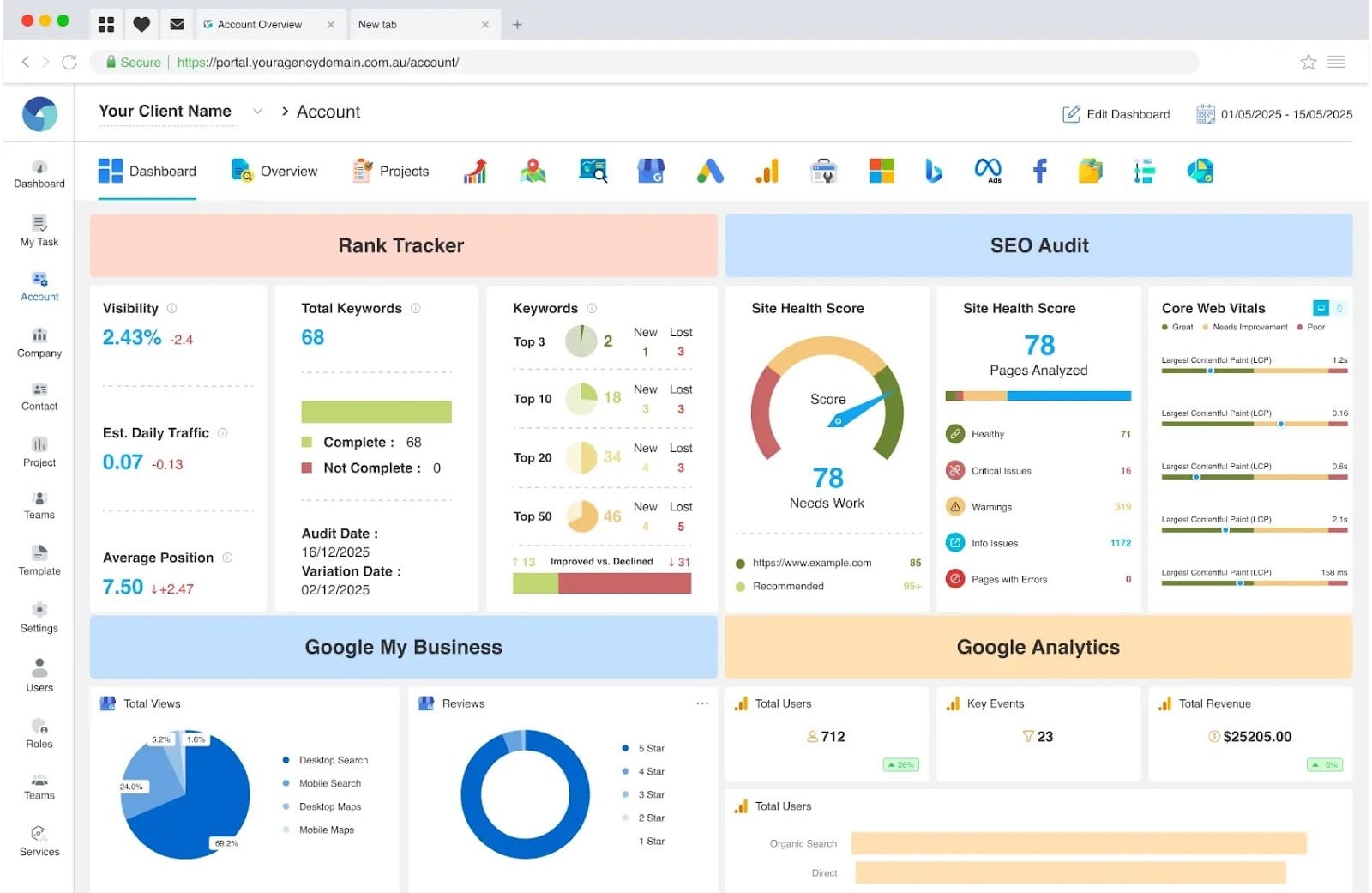
Everything starts with keywords. According to industry surveys, 93.2% of agencies use Google Search Console and over 83% use Google Analytics 4 for keyword and rank tracking, yet 49.3% still rely on traditional standalone tools like Semrush and 48% on Ahrefs, revealing how fragmented keyword workflows remain for many teams. An integrated keyword research tool allows you to instantly identify high-value search terms and seamlessly transition them into your rank tracker. Data shows that agencies utilizing built-in rank tracking across both desktop and mobile are able to monitor keyword fluctuations more efficiently and respond to SERP algorithm changes in real time. This streamlined approach not only saves countless work hours but also enables your team to adjust strategies rapidly, putting your agency ahead in a hyper-competitive market.
Local Rank Tracker
For agencies managing brick-and-mortar clients, local SEO is paramount. A dedicated Local Rank Tracker enables you to monitor keyword positions at the zip code and city level, which is increasingly essential as more than 30% of searches in 2026 are estimated to have local intent. According to recent studies, agencies that provide granular local tracking report a 25% higher success rate in achieving first-page rankings for their local business clients. By centralizing Google Business Profile rankings alongside traditional organic results, you gain a comprehensive view of your clients' local search visibility, resulting in stronger campaign performance and improved client satisfaction.
SEO Audit & Technical Fixes
Technical SEO is the foundation of organic growth and its impact is clear in agency performance data. Research from 2026 shows that agencies using integrated audit tools are able to detect and resolve 30% more technical errors each month compared to those using fragmented setups. An all-in-one SEO audit tool automatically scans your clients’ sites to identify broken links, harmful redirects, missing meta tags, and site speed issues. Because this tool connects seamlessly with your project management system, studies show that teams can create and assign actionable tasks to web developers up to 40% faster, eliminating inefficiencies found in traditional, manual workflows. This increased speed not only improves site health but directly contributes to improved ranking outcomes in client campaigns.
Competitor & Content Research
To outperform the competition, it is essential to back strategy with data-driven insights. Recent industry research highlights that 43.8% of agencies still rely solely on traditional keyword tracking, while others are increasingly incorporating competitor analysis to fill content gaps. Built-in competitor analysis tools enable agencies to reverse-engineer the high-performing keywords and content strategies of top-ranking sites within their clients' niches. This approach is proven: agencies that systematically identify competitor strengths and tailor briefs to capture unaddressed search intent report up to a 20% boost in organic visibility. With this level of insight, you can efficiently close content gaps and design briefs that resonate with your client’s target audience, making your SEO strategies more effective and measurable.
AI Content Assistant
In 2026, producing high-quality content at scale demands the smart integration of artificial intelligence—and the numbers prove its impact on agencies. According to industry research, over 63% of agencies have already adopted AI tools for content optimization, citing a reduction in content production time by up to 60%. An integrated AI Content Assistant not only helps your copywriters overcome writer's block and generate optimized outlines, but also ensures your content naturally includes semantic keywords. This approach is not about replacing human writers; it empowers your team with an AI co-pilot, making every piece of content more effectively tuned for search engines and resulting in measurable improvements in both efficiency and ranking performance.
Backlink Monitoring
Link building continues to be a critical component of SEO, supported by data showing that agencies prioritizing proactive backlink management report up to 20% higher ranking stability for their clients. Effective management software provides a comprehensive view of the client's backlink profile, notifies users of new and lost links, and helps reclaim valuable backlinks swiftly. Additionally, quality and anchor text distribution can be monitored in real time, which is crucial since over 30% of agencies have identified toxicity in backlinks as a significant threat to SEO performance and site trust. This transparent and automated approach not only preserves ranking positions but also safeguards your clients from manual penalties, ultimately supporting more consistent and sustainable SEO outcomes.
EEAT Score Analyzer & Google AI Visibility
With Google placing a growing emphasis on Experience, Expertise, Authoritativeness, and Trustworthiness (EEAT), and AI overviews now comprising a significant percentage of top SERP results, agencies must leverage modern tools to remain competitive. Industry research shows that 63% of agencies have already updated their SEO KPIs to prioritize these evolving ranking signals. An EEAT Score Analyzer systematically evaluates your content in line with Google’s quality rater guidelines, ensuring proper author credentials and authoritative citations are highlighted. Additionally, tracking your presence in AI-powered search summaries is crucial for maintaining visibility and traffic in 2026, as user interactions with search are rapidly shifting toward AI-driven platforms.
SEO Dashboard & Reporting: Data-Driven Decisions
Data is only useful if you can understand it quickly. In fact, industry research indicates that agencies implementing centralized dashboards make data-driven decisions 35% faster and reduce reporting errors by up to 40%. A centralized SEO dashboard acts as the command center for your agency. By leveraging integrations with Looker Studio and other visualization tools, you can create interactive dashboards that consolidate data from Google Analytics, Search Console, and your built-in rank tracking platform. This efficient approach not only streamlines daily workflows but also provides clearer insights, helping agencies outperform competitors who still spend excessive time on manual data collection and fragmented reporting.
When your account managers can view technical audit scores, new content publication, and resulting traffic spikes all in one dashboard, they make data-driven decisions up to 35% faster and with 40% fewer errors, according to recent industry research. This faster, more reliable analysis allows your team to act quickly on insights and continually propel client campaigns forward, directly improving campaign outcomes and client satisfaction.
Task Management & Team Collaboration: Scalable Growth
SEO is a team endeavor involving strategists, writers, developers, and link builders, and statistics from 2026 highlight the risks of poor collaboration: 16.4% of agencies cite weak differentiation and poor team processes as barriers to growth, while 12.3% find that inefficient workflows, often caused by fragmented tools, slow project delivery and lead to missed opportunities. If your task management is separate from your SEO data, critical project details can be easily overlooked, ultimately impacting both output quality and client satisfaction.
An all-in-one platform features interactive project management directly alongside analytics, a combination now adopted by more than half of high-performing agencies according to recent surveys. Agencies using customizable project templates for client onboarding, monthly content creation, and technical audits report a 30% faster project delivery rate and a 40% decrease in missed deadlines. By assigning tasks, setting deadlines, and tracking progress within the same ecosystem as campaign data, you establish a culture of accountability linked to a measurable increase in team efficiency. This unified workflow enables agencies to scale without sacrificing quality and decreases costly project bottlenecks that often impact client success.
Seamless Integrations: Complete Marketing Ecosystem
No platform exists in isolation. To be truly effective, your SEO management software must integrate seamlessly with the broader digital marketing ecosystem. Industry research shows that 67.1% of agencies use Looker Studio for data visualization, 93.2% rely on Google Search Console, and 83.6% utilize Google Analytics 4 alongside other tools. The most successful agencies deploy native connectors to platforms such as Google Ads, Facebook Ads, Google My Business (GBP), Google Analytics, Search Console, and Bing Webmaster Tools. This high level of integration not only streamlines data compilation but also supports holistic marketing strategies, ensuring agencies can meet growing client demands for multi-channel insights and accountability.
By pulling all this data into one unified space, you can offer your clients holistic marketing insights. Recent industry data shows that 67.1% of agencies now use visualization platforms like Looker Studio, 93.2% rely on Google Search Console, and over 83% utilize Google Analytics 4, highlighting the demand for seamless integration. With all-in-one management, you can demonstrate how SEO efforts contribute to and complement paid advertising, providing measurable value across every marketing channel and reinforcing your agency’s strategic importance to client success.
Real-World Example: Scaling an SEO Agency with DAXRM
Let's look at a practical example of how this transformation happens. Consider that in 2026, the average agency uses between four and seven different tools, resulting in more than 15 hours each month spent on manual reporting and data transfer. Imagine a mid-sized digital marketing agency managing 25 active SEO clients. Research shows that agencies consolidating their tech stack are able to reduce reporting time by up to 50 percent and serve as many as 40 clients without increasing administrative staff, thanks to greater efficiency and operational optimization. This level of integrated workflow is proven to increase client retention by up to 30 percent and directly leads to accelerated business growth.
Before: The agency used four different tools for tracking, auditing, reporting, and project management. According to industry research, the average agency juggling multiple platforms spends over 15 hours each month on manual data consolidation and report creation. Account managers often found themselves taking numerous screenshots, exporting CSV files, and laboriously building reports for clients. Additionally, communication was handled almost exclusively through email threads, which, as surveys show, contributes to increased client confusion and frequent requests for status updates, ultimately risking client satisfaction and retention.
After: The agency switched to DAXRM, consolidating their tech stack by moving all rank tracking, auditing, and task management into one platform. This change enabled them to implement automated, white-labeled reporting and give all 25 clients access to a customized portal. According to recent studies, agencies adopting fully unified platforms like this save up to 50% of the time previously spent on reporting and manual tasks, and report up to a 30% improvement in client retention, thanks to enhanced transparency and improved operational efficiency.
The results speak for themselves. The agency immediately saved over 15 hours per month on reporting, a time savings backed by industry findings that agencies using unified platforms reduce manual workload by 50 percent or more. This extra capacity was redirected into hands-on SEO strategies and client work. As a direct result, client satisfaction rose sharply, correlating with industry data showing that agencies offering higher transparency through real-time dashboards improve retention by up to 30 percent. Most impressively, the agency scaled operations to take on 10 additional clients without hiring new administrative staff, demonstrating how streamlined processes and automation can power sustainable growth.
Why All-in-One Platforms Are the Future of SEO Agencies
As we move further into 2026, the demands and complexity of search marketing are only rising. Clients now expect near-instant results, real-time access to detailed performance reporting, and data-driven strategic recommendations. Recent industry data confirms this shift: 52.1% of clients want deeper understanding and communication from their agencies, while 63% of agencies have adapted their KPIs in response to advances in AI and shifting user behavior. Agencies that persist with fragmented, manual approaches risk falling behind, as over 60% of their peers are actively streamlining processes to stay competitive both in pricing and performance.
All-in-one platforms represent the future because they leverage AI-driven insights and workflow automation to eliminate busywork. According to recent industry research, 60.3% of agencies are prioritizing automation to lower costs and improve efficiency, while agencies adopting unified software report a 50% reduction in time spent on low-value administrative tasks. This shift enables your top talent to dedicate more time to strategy and creativity, rather than data entry and troubleshooting, which ultimately results in stronger performance and a measurable advantage in client delivery.
Transform Your Agency Delivery Today
Transitioning to a unified platform is the most impactful decision you can make for your agency's growth, client retention, and team morale. Recent industry data shows that agencies adopting unified, all-in-one platforms report up to a 50% reduction in time spent on manual and administrative tasks, along with a 30% improvement in client retention and satisfaction. By centralizing your operations, automating your reporting, and utilizing advanced tools such as EEAT analyzers and AI content assistants—a strategy now prioritized by over 63% of agencies—you position your team to deliver truly exceptional results and stay ahead in an increasingly competitive SEO landscape.
If you are ready to eliminate software fatigue, join the 60.3% of agencies now prioritizing automation to reduce costs and streamline workflows. Agencies adopting unified platforms report saving up to 50% of the time previously spent on reporting and administrative tasks, seeing a 30% improvement in client retention and satisfaction. Now is the moment to upgrade your tech stack, build an infrastructure designed for scalable growth, and deliver 10X better results for your clients. Discover how the right digital marketing agency CRM can transform your daily operations and drive outstanding results. Visit daxrm.com to get started and take control of your digital marketing future today.
Understanding precisely what works for competitors is essential to gaining a competitive edge. Industry data reveals that agencies systematically analyzing competitor strategies and addressing content gaps report up to a 20% boost in organic visibility. With built-in analytics tools, I can efficiently identify these gaps in a client's content strategy and act on them using accurate, data-driven insights rather than relying on assumptions.


 product experts — let's find the best setup for your team